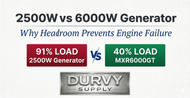
2500W vs. 6000W Generator:
Why "Headroom" Prevents Engine Failure
Ask any small engine mechanic what kills generators early. The answer isn't hours — it's hours at 90% load. The MXR6000GT running your 2,500W draws at 40% capacity. A smaller generator doing the same job is already redlining.
⚠ Running Stressed
2,500W Generator
2,500W max / 2,200W rated running — delivering your 2,000W load
Load % (based on rated running watts) 91%
✓ Running Comfortable
MXR6000GT
6,000W max / 5,000W rated running — delivering the same 2,000W load
Load % (based on rated running watts) 40%
Load % and headroom are calculated against each generator's rated running watts — the continuous output the engine is designed to sustain — not max/peak watts.
Examples of Running Watt Loads by Use
RV + AC
A realistic RV load with rooftop AC, fridge, TV, lights, and charging.
| Appliance |
Source |
Running Watts |
| Dometic Brisk II 13,500 BTU rooftop AC |
Dometic.com ISO 5151 spec |
1,670W |
| Norcold N3150 compressor fridge |
Norcold published spec |
150W |
| 32" Vizio LED TV |
Vizio spec sheet |
35W |
| 2× LED light strips |
10W/strip |
20W |
| USB charging hub (phones + tablet) |
45W USB-C hub at load |
45W |
| Total Continuous Load |
MXR6000GT load: 38% of 5,000W rated |
1,920W |
All wattages are manufacturer-published running watts. Startup surge figures are separate — see the surge section below.
Tailgate
Electric griddle, cooler, TV, fans, string lights, and device charging.
| Appliance |
Source |
Running Watts |
| Blackstone E-Series 17" electric griddle |
Blackstone.com — 1500W/120V |
1,500W |
| Koolatron P27 cooler (AC adapter) |
Koolatron.com — 4.5A × 12V |
54W |
| 32" LED TV |
Vizio spec sheet |
35W |
| 2× box fans (Lasko) |
Lasko spec — 100W/fan high |
200W |
| 25ft LED string lights |
Typical outdoor string |
40W |
| USB charging (4 phones) |
~15W/phone |
60W |
| Total Continuous Load |
MXR6000GT load: 38% of 5,000W rated |
1,889W |
All wattages are manufacturer-published running watts.
Off-Grid Cabin
Window AC, coffee maker, lights, laptop, and phone charging.
| Appliance |
Source |
Running Watts |
| LG LW1016ER 10,000 BTU window AC |
LG spec sheet — running |
900W |
| Black+Decker CM1160B coffee maker |
Black+Decker spec |
900W |
| Box fan (Lasko) |
Lasko spec — high |
100W |
| 4× LED bulbs (60W equiv.) |
9W/bulb |
36W |
| MacBook Pro 16" |
Apple 96W USB-C adapter |
96W |
| 2× phone charging |
~15W each |
30W |
| Total Continuous Load |
MXR6000GT load: 41% of 5,000W rated |
2,062W |
Coffee maker runs ~10 minutes per brew cycle — not continuous. Shown at full draw for worst-case calculation.
Campsite Comfort
CPAP, cooler, fan, lights, griddle, and charging.
| Appliance |
Source |
Running Watts |
| ResMed AirSense 10 CPAP w/ humidifier |
ResMed user manual — 53W avg, 104W max |
53W |
| Koolatron P27 cooler (AC adapter) |
Koolatron.com — continuous |
54W |
| Box fan |
Lasko spec — high |
100W |
| 4× LED bulbs |
9W/bulb |
36W |
| Blackstone E-Series 17" griddle (meals) |
Blackstone.com — 1500W/120V |
1,500W |
| 2× phone charging |
~15W each |
30W |
| Total Continuous Load |
MXR6000GT load: 35% of 5,000W rated |
1,773W |
Griddle runs during meal prep, not all night. CPAP runs overnight at low continuous draw. Peak simultaneous load shown for worst case.
What Load Does to Engine Heat — and Why It Matters
A gasoline engine converts fuel into two things: useful mechanical power and heat. Only about 20–30% of the fuel's energy becomes shaft power. The rest — 70–80% — becomes heat that the engine has to shed through its cooling fins, exhaust, and oil. As load increases, fuel consumption rises, combustion energy rises, and heat production rises with it. The relationship is roughly proportional.
| Engine Load |
Fuel Burn |
Heat Generated |
Cooling Margin |
MXR at This Load |
| 25% load |
Low |
Low |
Large |
~1,250W output |
| 40–50% load |
Moderate |
Moderate |
Comfortable |
2,000–2,500W — your load |
| 80–100% load |
High |
High |
Minimal |
4,000–5,000W output |
◆
Engine Oil
Oil does double duty: lubrication and heat transfer. At high load, oil temperature rises, viscosity drops, and the film protecting bearing surfaces thins out. Elevated temperature also accelerates oxidative breakdown. Running at 40% load means lower oil temps, slower degradation, and longer oil life.
▲
Exhaust & Muffler
In a small air-cooled engine at full load, exhaust valve face temperatures can exceed 1,100°F. Muffler surface temperatures at full load can reach 400–500°F. At 40% load, both drop substantially.
⚙
Piston Rings
At full load, peak combustion pressures are significantly higher than at moderate load. Ring faces push harder against the cylinder wall, increasing friction and wear rate. At 40% load, peak pressures are lower and the rings operate in cooler, less stressful conditions.
⚡
ECO Mode
ECO mode works by throttling the engine down when demand drops. A generator already running near its limit has to stay at high RPM to meet demand. The MXR6000GT running your 2,000W load has 3,000W of headroom, which is exactly the margin ECO mode needs.
Same Fuel. Same Runtime. One Generator Has Room Left.
Honda publishes runtime at rated load — one of the few manufacturers that does. These numbers come directly from Honda's own product pages. The comparison below shows each Honda running at 100% of its rated running watts versus the MXR6000GT delivering 2,500W.
Note on data limitations: Full-load runtime data is rarely published by generator manufacturers. Honda is one of the few that provides it consistently, which is why they are used here for comparison.
| Generator |
Max Watts |
Rated Running Watts |
Watts Delivered |
Load % |
Runtime |
Fuel Used |
| Honda EU3200i |
3,200W |
2,600W |
2,600W |
100% |
3.3 hrs |
1.2 gal |
| Honda EU3000iS |
3,000W |
2,800W |
2,800W |
100% |
6.9 hrs |
3.4 gal |
| MXR6000GT |
6,000W |
5,000W |
2,500W |
50% |
6.7 hrs |
3.0 gal |
Note on Noise. Honda is quieter and we know that is important. They make an excellent generator and it is a solid choice if they fit your needs.
Startup Surge: The Load Nobody Plans For
Every motor-driven appliance draws significantly more power at startup than it does while running. The compressor in your AC unit, the motor in your fridge — they need a surge of current to overcome inertia and get spinning. A generator already running near its rated capacity has almost no room to absorb these spikes. The MXR6000GT running at 40% load has 3,000+ watts of instantaneous headroom available.
Dometic Brisk II AC
Running1,670W
Startup Surge2,800–3,500W
A 2,500W generator powering a 1,670W AC is already at 67% load before the compressor even tries to start.
RV Compressor Fridge
Running150W
Startup Surge400–600W
Compressor cycles on every 15–20 minutes. Each cycle is a surge event on top of your existing load.
Window AC 10,000 BTU
Running900W
Startup Surge1,900–2,200W
More than double the running load for the first half-second. Common cause of generator trips on undersized units.
The Generator That Matches Your Load
Is Working Twice as Hard to Deliver It.
- ✓A 2,500W generator running a 2,000W load is at 91% of its rated running watts — continuously, for hours.
- ✓The MXR6000GT running that same load is at 40% — lower fuel burn per watt delivered, lower exhaust temps, slower oil degradation.
- ✓ECO mode can actually engage, because there's headroom to let the engine slow down.
- ✓Startup surges from AC compressors and motor-driven appliances are absorbed without overload or stall.
The Honda is a great generator. So is the MXR. They're doing different things when they deliver your 2,500 watts, and only one of them has room to breathe.
Ready to run at 40%?
The MXR6000GT is available now with free shipping. Questions? Call/Text 314-833-8000. Email sales@durvy.com.
View the MXR6000GT →